Baked Portuguese Pastel de Nata with Blistered Tops
Jump to Recipe
Baked Portuguese pastel de nata are small custard tarts with a flaky, spiral-layered shell and a sweet egg-yolk filling scented with cinnamon and lemon. This version uses store-bought all-butter puff pastry and a stovetop custard, so a batch of 12 comes together in about an hour.
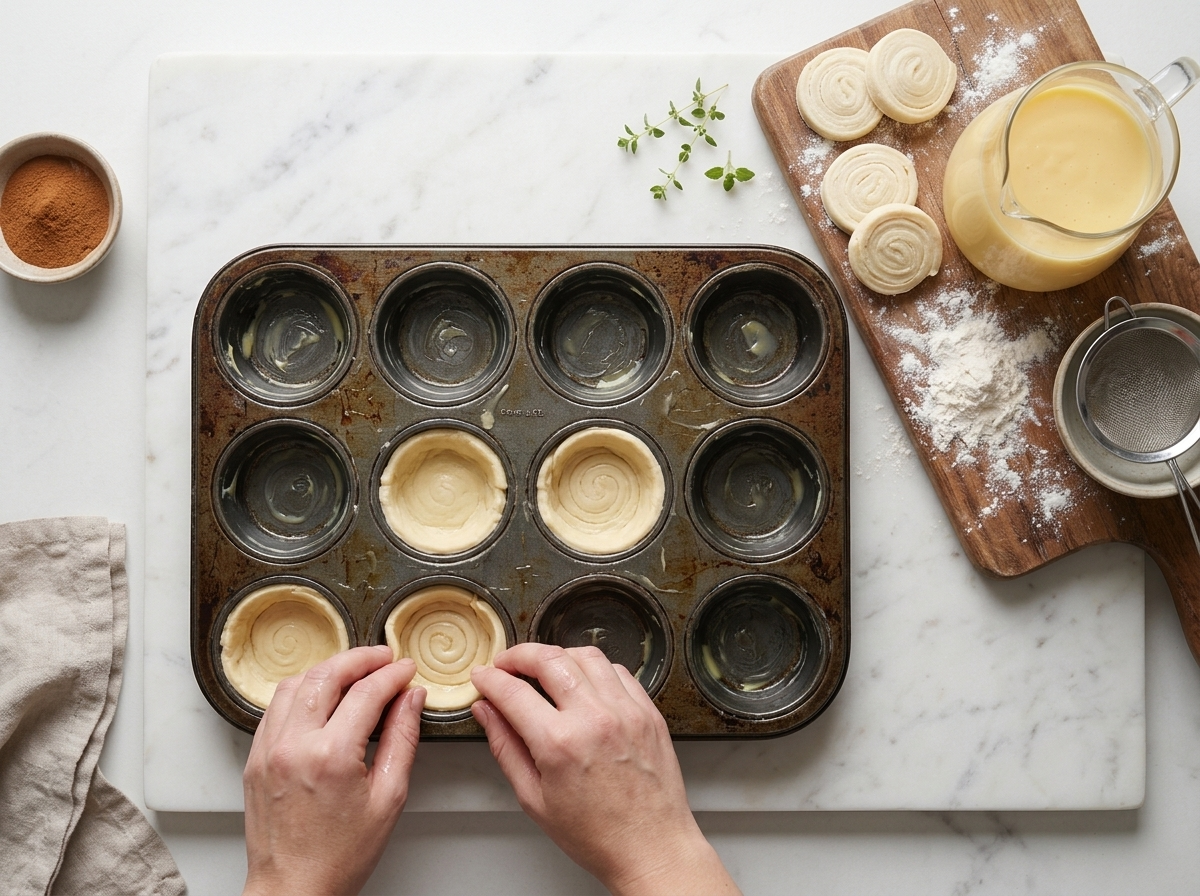
The shell comes from rolling the pastry into a log, slicing it into discs, and pressing each one thin with wet thumbs. That keeps the spiral layers visible and gives you walls that crisp up instead of puffing into a dome.
Heat is the other half. Set the oven to 250 C / 480 F, or as hot as yours goes, because the dark blistered spots on top only form in fast, intense heat.
One judgment call matters here: fill each shell to about three-quarters, roughly 60 ml. Overfill and the custard bubbles over the rim, glues the tarts to the tin, and tears the shells when you lift them out.
Why You’ll Love This Recipe
- Store-bought puff pastry gives flaky spiral shells without lamination
- The stovetop custard bakes up smooth rather than grainy
- Pastry log and custard both keep 2 days for make-ahead baking
- Twelve tarts from one pastry sheet and a handful of pantry staples
Ingredient Notes
- all-butter puff pastry: Use one 320 g sheet, thawed in the fridge until pliable but still cold. Dairy-free puff pastry also works, though the shells taste less rich.
- heavy cream: Half-and-half can replace it, but the custard sets a little looser and the tops blister less. I use heavy cream for a cleaner slice and deeper color.
- all-purpose flour: Swap 30 g flour for 20 g cornstarch if you want a glossier custard. Cook it until it bubbles so the starch fully thickens.
- lemon peel: Orange peel works as a swap. Use a vegetable peeler and skip the white pith, which turns the syrup bitter.
- egg yolks: Stick with yolks. Whole eggs make a paler, looser filling. Save the whites for an omelet or meringue.
- cinnamon stick: Ground cinnamon clumps in the hot syrup. If you only have ground, whisk 1/2 tsp into the milk and flour mixture instead.
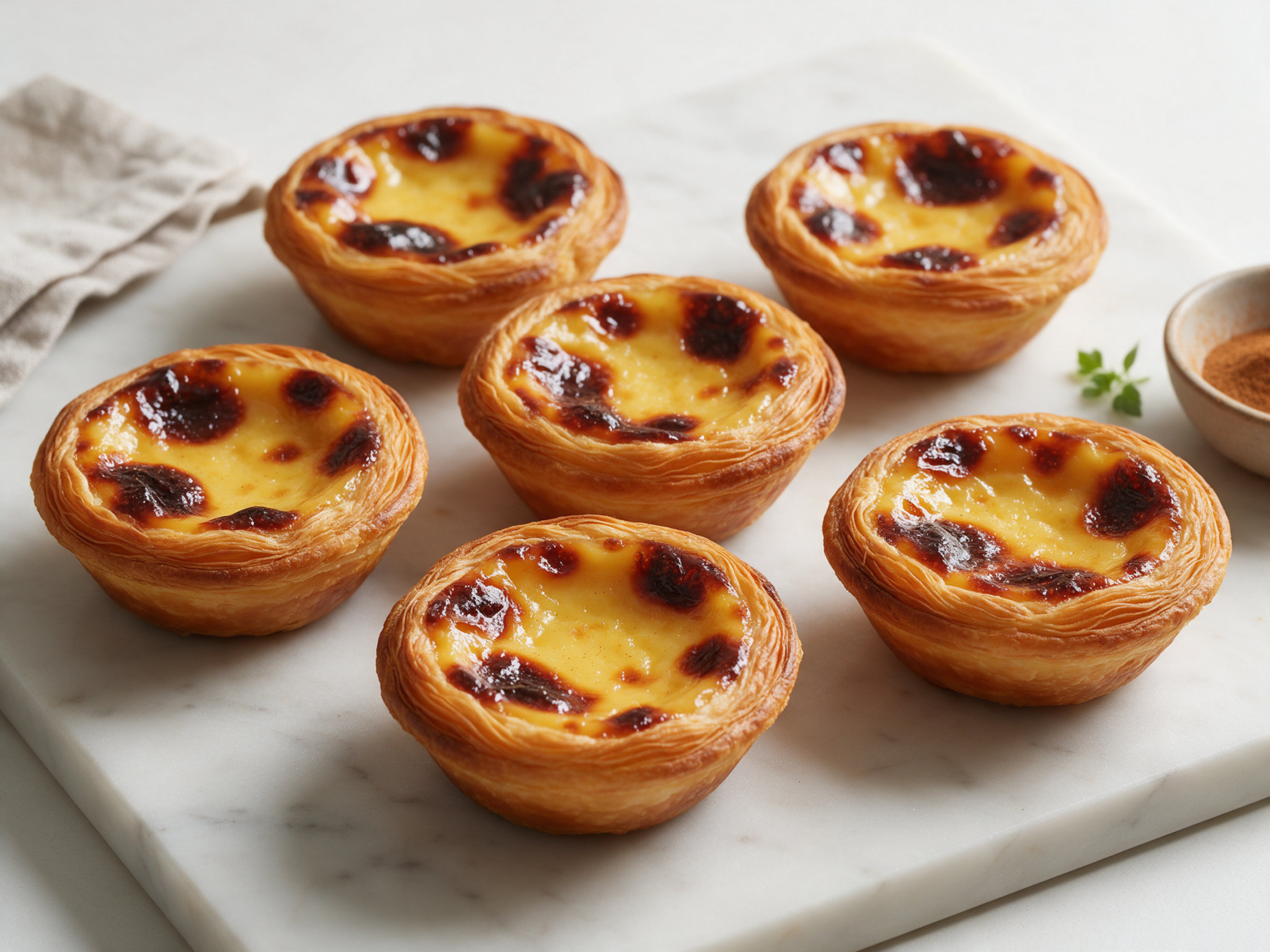
Baked Portuguese Pastel de Nata with Blistered Tops
Ingredients
Method
- Unroll the thawed puff pastry on a lightly floured counter. Brush the surface with half of the melted butter (15 g), then roll it up tightly into a log about 25 cm / 10 inches long. Wrap the log and chill it for 20 minutes while you make the custard.
- Combine the sugar, water, cinnamon stick, and lemon peel in the 1-quart / 950 ml saucepan. Bring to a boil over medium heat, then simmer for 5 minutes without stirring, until slightly syrupy. Take the pan off the heat.
- Whisk the 30 g flour with 60 ml of the cold milk in a bowl until no lumps remain. Heat the remaining 240 ml milk, the cream, and the salt in the 2-quart / 1.9 L saucepan over medium heat for 3 to 4 minutes, until steaming at the edges. Whisk in the flour mixture and cook for 3 to 4 minutes, stirring constantly, until it thickens like pudding. Lift the cinnamon and lemon peel out of the syrup, then pour the hot syrup into the milk base in a slow stream while whisking. Cool for 10 minutes, stirring now and then, until warm to the touch.
- Whisk the egg yolks and vanilla into the cooled custard until fully blended. Strain through the fine-mesh sieve into the jug.
- Set a rack in the upper third of the oven and heat to 250 C / 480 F. Brush the 12-cup muffin tin with the remaining melted butter. Unwrap the pastry log and slice it into 12 discs about 2 cm / 3/4 inch thick. Place each disc cut side up in a cup, dip your thumbs in cold water, and press into the center, then push the pastry up the sides until the walls are about 3 mm thick and just clear the rim.
- Fill each shell about three-quarters full, roughly 60 ml. Bake for 13 to 15 minutes, checking from 12 minutes, until the pastry edges are deep golden and the custard tops have dark brown to black blisters.
- Cool the tarts in the tin for 10 minutes, then loosen each with a butter knife and move to a wire rack. Dust with ground cinnamon and powdered sugar if you like, and serve warm.
Notes
- Thaw the puff pastry in the fridge until pliable but still cold.
- Strain the custard even if it looks smooth.
- Fill shells to three-quarters, about 60 ml each.
- Serve within 2 hours of baking for the crispest shells.
Tips for Success
- Pour the hot syrup into the thickened milk base in a slow stream while whisking, so the custard stays smooth and glossy.
- Cool the custard base for 10 minutes, until warm to the touch, before whisking in the egg yolks.
- Strain the finished custard through a fine-mesh sieve even if it looks smooth, to catch any flour lumps or stray egg strands.
- Dip your thumbs in cold water before pressing each pastry disc, and stop when the walls are about 3 mm thick.
- Check the tarts at 12 minutes and pull them when the tops are deep brown with black flecks, since oven hot spots differ.
Variations
- Replace the lemon peel with a wide strip of orange peel and add a pinch of nutmeg to the custard for a warmer flavor.
- Make mini tarts in a 24-cup mini muffin tin with about 30 ml custard each, and bake for 10 to 12 minutes.
- Use 1 tsp vanilla bean paste instead of extract for visible flecks and a rounder vanilla note in the finished custard.
Storage and Reheating
Baked pastel de nata keep for up to 2 days in an airtight container in the refrigerator. Egg custard shouldn’t sit at room temperature longer than 2 hours, so refrigerate any leftovers once that window passes.
To reheat, set the tarts on a sheet pan in a 180 C / 350 F oven for 6 to 8 minutes, until the shells crisp again and the custard is warm. The microwave softens the pastry, so use the oven.
For make-ahead baking, keep the wrapped pastry log in the fridge for up to 2 days, or freeze it for up to 1 month and thaw it overnight in the fridge. Strained custard also holds for 2 days in the fridge with plastic wrap pressed on its surface. Baked tarts don’t freeze well because the custard turns watery after thawing.
Serving Suggestions
Serve pastel de nata warm, within 2 hours of baking, when the shells are at their crispest. Dust with ground cinnamon and a little powdered sugar at the table, the way Lisbon bakeries do.
A small espresso or a milky galão is the classic match, and the bitterness cuts the sweet custard. For an after-dinner plate, pour a small glass of tawny port.
The tarts also sit well on a brunch table next to fresh fruit and plain yogurt. Because they’re small, one or two per person works beside a full meal, and a batch of 12 covers a crowd.

FAQ
How do I know when pastel de nata are done baking?
Pastel de nata are done when the pastry edges are deep golden and the custard tops carry dark brown to nearly black blisters, usually 13 to 15 minutes at 250 C / 480 F. Start checking at 12 minutes because oven hot spots vary. The centers still jiggle slightly on the way out, then set as the tarts cool for 10 minutes.
Can I use cornstarch instead of flour in pastel de nata custard?
Yes, swap the 30 g of flour for 20 g of cornstarch and whisk it into the cold milk the same way. Cook the base until it bubbles and turns thick, about 2 minutes, since cornstarch thickens faster. The custard comes out slightly glossier, and the tarts bake in the same 13 to 15 minutes.
Can I freeze pastel de nata, or should I freeze the dough?
Freeze the wrapped pastry log, not the baked tarts. The log keeps for 1 month, then thaws in the fridge overnight before slicing. Baked tarts lose their crispness and the custard turns watery after thawing, so bake a fresh batch and refrigerate any extras for up to 2 days.
What drink goes best with pastel de nata?
Espresso, called a bica in Lisbon, is the classic pairing because its bitterness cuts the sweet custard. A galão, the tall milky Portuguese coffee, gives a softer match. After dinner, a small glass of tawny port echoes the cinnamon and caramelized notes on top of the tart.
Is pastel de nata vegetarian, and can I make it dairy free?
Pastel de nata is vegetarian as long as your puff pastry is all-butter and free of animal-derived additives, though it contains eggs and dairy. For dairy free, use dairy-free puff pastry, 300 ml oat milk, and 200 ml canned coconut cream. The custard sets slightly softer and tastes faintly of coconut.
What is the difference between pastel de nata and a Hong Kong egg tart?
Pastel de nata has a laminated puff pastry shell and a custard flavored with cinnamon and lemon that bakes with dark blistered spots. Hong Kong egg tarts usually use a shortcrust or puff shell and a smoother, paler custard without the scorched tops. Macau egg tarts sit in between, since they were adapted from the Portuguese tart.
If you enjoyed this, try
About The Author

John
John Watson is the passionate food enthusiast behind MePlusFood.com. With a deep love for exploring culinary delights, he shares honest restaurant reviews, mouthwatering recipes, and culinary adventures. Join John on his flavorful journey to savor the world one bite at a time.